
【Factorio】How to Build a Main Bus and Decide Its Width
The main bus is one of the most manageable factory designs in Factorio, flowing primary materials in one direction and branching to each production line. This article uses vanilla v2.0 as the basis, working with figures like yellow belts at 15 items/second, red belts at 30 items/second, and stone furnaces at 48 units per one yellow belt line, to define what a main bus is, explain why the standard '4 belts + 2 tiles' layout is widely used, and provide evidence-based guidance on how many iron plat
【Factorio】How to Build a Main Bus and Decide Its Width
The main bus is one of the most manageable factory designs in Factorio, flowing primary materials in one direction and branching to each production line. This article uses vanilla v2.0 as the basis, working with figures like yellow belts at 15 items/second, red belts at 30 items/second, and stone furnaces at 48 units per one yellow belt line, to define what a main bus is, explain why the standard "4 belts + 2 tiles" layout is widely used, and provide evidence-based guidance on how many iron plates, copper plates, and green circuits to run.
I've personally hit the point where copper dried up immediately after unlocking blue science, forcing me to almost completely rebuild a thin bus. From that experience, I can say strongly that whether a main bus runs stably in mid-game onwards depends on establishing the width at 2–3 times larger than initially needed, rather than on keeping the appearance tidy.
This article is positioned as an entry point into design that moves beyond "just arranging things" to making decisions backed by numbers—useful for beginners; and as a baseline for intermediate players to refine whether a standard bus of around 14 lines fits your factory's scale.
What Is a Main Bus in Factorio? Prerequisites Before Deciding Width
Definition and Role of the Main Bus
A main bus is a design technique that consolidates primary materials like iron plates, copper plates, steel, and electronic circuits into a single direction of flow, then splits sideways at necessary points to branch to individual production lines. It's easiest to grasp if you think of it as building the backbone of the entire factory first, then branching individual lines off that backbone to red science, green science, ammunition, module materials, and so on.
The reason this approach is favoured in Factorio is straightforward: you can see the flow of "goods" rather than wires. It becomes easy to survey at a glance where iron flows, where copper dries up, and which materials are getting jammed, making the factory less likely to turn into spaghetti. Factory design guides also establish this idea of placing major resources on the backbone and splitting them to individual lines as a fundamental principle.
Let's establish terminology first. Transport belts are the basic equipment for moving materials; yellow ones flow 15 items/second, while red ones flow 30 items/second. Underground belts let you run belts below ground to avoid intersections; in a main bus, they're frequently used to handle branching and crossings cleanly. It's important not just for tidying appearance, but for making clear which lines are primary and which are branches.
A much-discussed standard layout is placing 4 belts as one group with gaps between groups. This isn't a mathematical optimum so much as a practical standard that stuck around because branching, crossing, and expansion became easier. For instance, arranging 4 iron plates, 4 copper plates, 2 green circuits, and 2 steel materials makes it instantly clear what material band has how many lines.
My own early experience was to think "sounds convenient—I'll cram every intermediate material into the central trunk too," dumping gears, copper wire, brick, coal—you name it. Visually tidy, but the horizontal width ballooned and the distance to branch points grew, tanking efficiency. A main bus works best when understood as not a dumping ground for everything, but a trunk line carrying only the primary materials you'll use repeatedly throughout the factory.
Merits and Drawbacks of Adoption
The main bus's greatest merit is visibility. With a single-direction flow of materials, if you're short on iron, you follow the iron trunk; if copper runs out, you trace the copper trunk to find the cause. Expansion is straightforward too—just plant a new assembly block next to the existing line, cut the materials you need from the bus, and go. This makes it easy to plan scale-ups. It's documented in detailed guides like "The Ways of Factorio Factory Design: Mastering the Standard Main Bus" that clarity and expandability are major advantages of this approach.
A second strength is standardisation of branching. Rather than inventing a new wiring diagram each time, just having a template—"run the trunk vertically, assemble on one side, pull only needed materials sideways"—saves enormous thought. Beginners especially get confused not by material shortages themselves but by figuring out routing. A main bus cuts that confusion in half. It's outstanding as a gateway to learning factory design patterns because it reduces the amount you have to think about.
The flip side has equally clear weaknesses. First, it consumes significant space. You're reserving empty lanes and gaps between groups for the future, so identical production volumes need more land than tighter designs. Additionally, because you're transporting materials over long distances, belt consumption increases. This is a heavy burden early on, especially if you load up on materials "just in case"—you end up with massive infrastructure before the factory has matured.
Efficiency-wise, the main bus isn't an optimal-efficiency approach. For megabase designs prioritising UPS or SPM, direct-to-rail, dedicated lines, and on-site production become more rational. Take electronic circuits: consumption is huge and the link to copper wire is strong. The ratio shows that to flow 15 items/second of electronic circuits requires 22.5 items/second of copper wire. Just seeing this makes it clear that running copper wire down a long trunk is worse than building a dedicated block from copper plate through to finished circuit, then flowing only the finished circuits back into the bus.
💡 Tip
Treat the main bus not as "unifying the entire factory" but as "putting only commonly-used, high-consumption materials on a common trunk line." This perspective makes failures less likely.

The Ways of Factorio Factory Design: Mastering the Standard Main Bus
In the world of Factorio, the core gameplay revolves around automating the entire process of mining resources, processing them, and assembling products. Designing such a huge automated factory efficiently is crucial to progression. Various design philosophies exist…
welovefactorio.comTarget Version and Scope of This Article
This article centres on vanilla v2.0. While main bus thinking has been widespread across older versions, I'm narrowing the scope to the current vanilla environment so readers can actually make decisions. This focus matters because how you decide bus width ties directly to your entire logistics design. In vanilla, organising and flowing primary materials on Nauvis often forms a core strong pattern, functioning as a foundation for standard factory building.
Space Age is a paid expansion released 2024-10-21. During Nauvis early-game setup, main bus effectiveness remains quite similar. Organising iron plates, copper plates, steel, and circuits on the trunk, ensuring stable supply of research and intermediates—this logic still applies. However, mid-to-late game brings multi-planet operations and separate logistics systems into play, so extending a single main bus all the way to endgame isn't a given assumption. Thus this article treats Space Age as supplementary, distinguishing it from vanilla's standard design.
In Space Age, the premise of "unknown materials arrive later" grows stronger, so some practical examples use even wider bus widths. Conversely, there's less need to load everything into the trunk; materials like blue circuits or sulfur, whose consumption concentrates in certain places, are often better handled in adjacent blocks. The clearest way to understand this is: main buses work in Nauvis early game, but later stages benefit from mixed designs.
Main Bus Layout Basics|Why 4 belts + 2 tiles Became Standard
The Logic Behind 4 Belts Per Group + 2 Tiles Gap
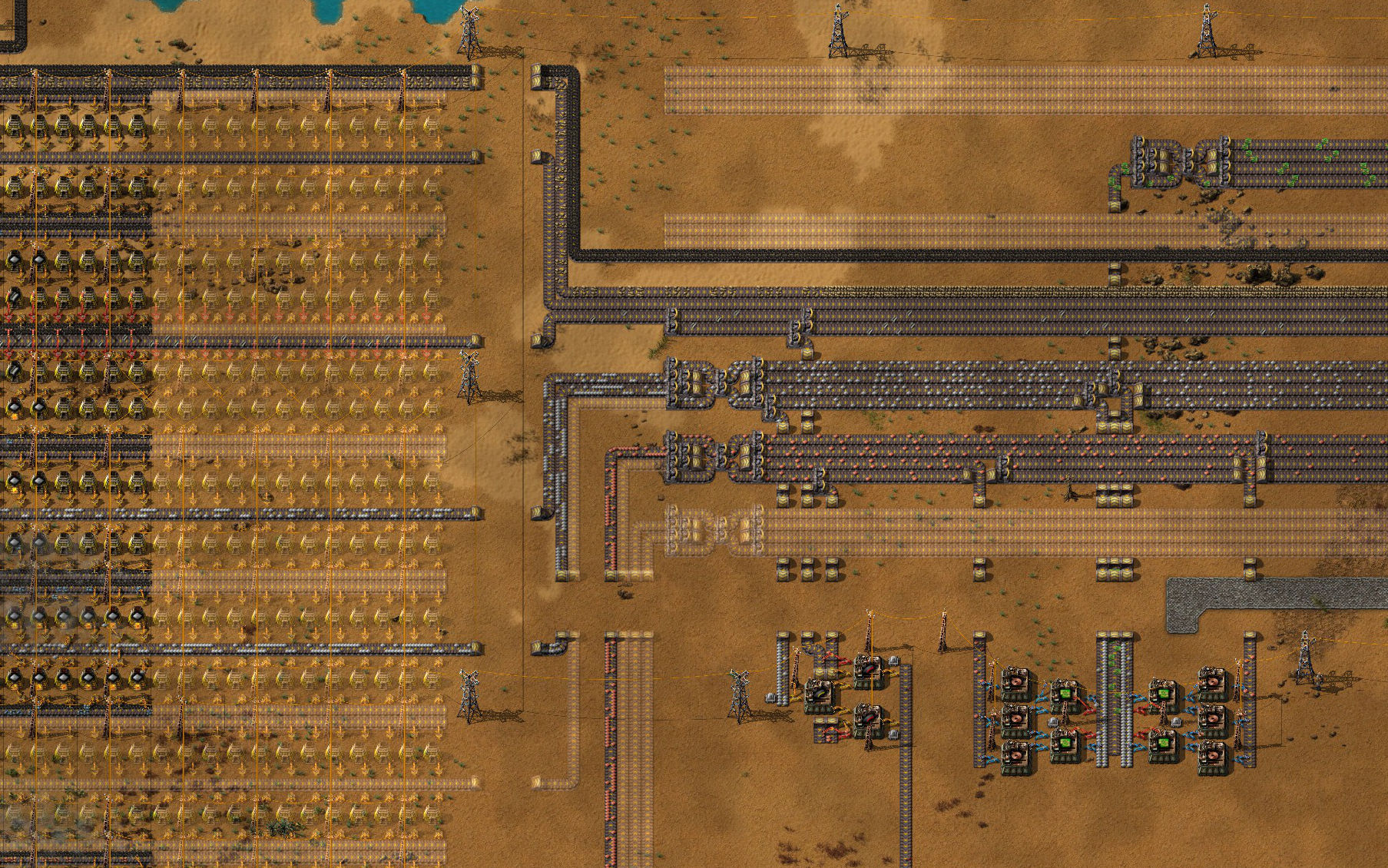
The standard main bus widely used is grouping 4 belts together with a 2-tile gap between groups. This isn't an aesthetic convention but rather extremely sensible when you plan for repeated branching. Keeping 4 belts tight lets you handle "the same material as a bundle"—4 iron plates, 4 copper plates—and at a glance you see where one material band ends.
The crucial part is the 2-tile gap between groups. This isn't empty space. It becomes an escape route when using underground belts for crossings and extractions, making it easier to avoid belts crossing each other. It functions as a walking route and provides space to place power poles feeding each assembly line. In other words, treating 4 belts plus a 2-tile margin as one unit makes transport, branching, and maintenance all work together smoothly.
I used to think gaps were wasteful and crammed belts together, but the instant I switched to 4-belt + 2-tile grouping, the sense of doing major reconstruction every branch vanished. Underground belt swaps alone settled branching shapes cleanly, and adding assembly lines later didn't easily break the main line. This operational lightness is the biggest reason it's held up as standard.
Main bus design guides and resources like "Designing a Main Bus Factory" present this approach of bundling 4 belts with margins as foundational. While you needn't absolutely reject 3 or 6 belts, the practical ease of the 4-belt break is extremely well-balanced.
【Factorio】Strategy Blog ③ Designing a Main Bus Factory|Maruwaka Blog
This time we'll design a main bus factory. Since main bus factories get large, you need to secure space beforehand, and shift-click ghost placement becomes invaluable. About smelters: my standard is 1 row of 24 smelters…
maruwakablog.comBranching, Merging, and the Outside-First Logic
The 4-belt layout is strong because it pairs well with branching methods based on underground belts. In a main bus, you'll often want to pass materials sideways without stopping the main line. If you always force extraction from the inside, you have to cross other belts repeatedly, rapidly turning the wiring complex. With 4-belt bundles, you can extract relatively straightforwardly from either outer edge.
The principle I use as a guideline is "extract from the outside belt first." With 4 belts, pull from the outermost one nearest the assembly area, then move inward as needed. This fixed rule makes decisions at each branch point much simpler. You stop wondering "pull from the dead centre or the edge?" every time.
Outside-first has benefits beyond appearance too. If you want materials to reach all the way to the bus terminus stably, letting lines on the bus head consume from outside-in rather than ganging up on the inside keeps flow traceable. When supplying critical lines, you can more easily read which belt is being used how heavily. As a result, you can predict how the end section depletes.
The same thinking applies to merging. When you later expand a smelter line or circuit production back onto the bus, having a clear understanding of which bundle and which position keeps the main line's organisation intact. A main bus is stronger when kept on consistent rules than on shortest paths. Grouping by 4 gives you a rule made visible.
💡 Tip
When branching gets confusing, first check whether you can pull from the outside. This alone makes underground belt routing much more straightforward and keeps the main line intact during expansion.
Single-Side vs. Both-Sides Layout—the Tradeoff
Once your main bus is in place, whether you extend assembly areas to just one side or spread to both sides hugely affects how manageable your factory is. In pure area efficiency, both-sides looks attractive—the same bus length can feed production lines left and right, compressing the footprint.
However, when you factor in operational ease, single-side is dramatically easier for beginners through intermediate players. The reason is simple: branching direction, power routing, walking paths, and expansion space all align in one direction. If you decide to only build assembly blocks to the bus's right, all extractions stay consistent in their rightward direction. It's easy to follow what material came from where; adding line extensions later stays as simple as "build to the right."
Both-sides gets difficult because your rules double. Pull copper and iron in this order on the right, but on the left detour underground extra times—small exceptions pile up and suddenly the main line loses visibility. When you later expand on one side and it interferes with the other's branching positions, tracking where space remains becomes fuzzy. Width efficiency rises, but decision overhead during expansion swells.
I went through a phase trying to keep things compact with both-sides. After blue science, I was essentially clogged every time I expanded. In particular, "I think I was using this material on the right too" and "I can't remember where I pulled steel from on the left" meant one small branch fix would snowball into whole-line rebuilds. Shifting toward single-side stretched space a bit, but the time I could mentally track the factory's state became dramatically longer.
The main bus originally trades area efficiency for structural clarity. Holding that premise, laying down 4+2-tile bundles, extending assembly only to one side, and keeping branching outside-first as a rule—these three together bump bus usability up a notch.
Deciding Main Bus Width|Working Backward from Demand to Calculate How Many Lines
Decide Your Target Stage First (Red/Green, Blue/Purple/Yellow, Pre-Rocket)
Main bus width stays consistent if you decide which tech stage you want this bus to carry rather than loosely "taking it wide." I split this into three stages: through red/green, through blue/purple/yellow, and through pre-rocket. Width stems from demand, not terrain, so fixing the endpoint is the starting point of design.
If your target is red/green, a smaller bus can still handle it nicely. Centre on iron plates, copper plates, and green circuits, making extras sideways as needed—plenty of room. Aiming through blue/purple/yellow raises iron and copper consumption noticeably and makes green circuits harder to dismiss. Stretching all the way to pre-rocket means starting with "2 of each" almost certainly chokes partway through.
The key is not trying to put every material on the bus from the start. Your baseline for deciding width should be versatile materials like iron, copper, and green circuits—these chain through multiple production lines, hitting bus width directly. Conversely, materials with narrow end-use are better spun off as dedicated lines once needed. And note that "around 14 lines total" is just a common community ballpark, not gospel; if you adopt a strict design value, back-calculate from your own target stage and supply capacity.
Where I struggled early was here too. Extending past red/green toward blue science with the same mental model meant looking identical on the surface, but actual load was very different. Deciding width vaguely beforehand meant when shortages hit, "why is this dry?" stayed invisible. Cutting your target stage first makes both the maths for necessary lines and later expansion decisions feel grounded.
Working Backward from Belt Capacity and Smelting Power
The practical work of width-setting is converting required quantity into how many belt lines. The steps are: 1. decide your target stage, 2. estimate needed volume of frequently-used materials, 3. convert smelting capacity and belt throughput into line counts, 4. add slack and finalize width. The numerical foundation here is that yellow belts flow 15 items/second, red belts 30 items/second. Switching to red midway gives the same single line double bandwidth.
Confirming the smelting side is equally vital. One stone furnace produces iron plate at 0.3125 plates/second, so filling one yellow belt line of iron plate takes 48 furnaces. A steel furnace takes 24 furnaces per yellow belt line. This means if you want 2 iron lines on your bus, just laying 2 belts isn't enough—you need either 96 stone furnaces or 48 steel furnaces backing supply. Placing a 4-belt iron bus without sufficient smelting behind it leaves you with a visually wide but materially empty trunk.
Green circuits follow the same path—work backward from needed volume. Electronic circuit ratios are copper wire 3 : electronic circuit 2, so running green circuits at one yellow belt line (15/second) requires 22.5 copper wire/second. But converting that 22.5/second into "how many belts" and "how many assemblers" requires knowing which assembler types you use (their craft speed) and whether modules matter. The practical workflow is: 1) decide target items/s, 2) check the recipe's craft time per item and output, 3) calculate assembler count from craft speed, 4) convert that production speed to belt line count—. When showing an example of unit conversion, explicitly state which assembler types are used (Assembling machine 1/2/3) and cite primary sources like Factorio Wiki.
The design trick is making versatile materials thick on the trunk, shunting specialty materials to dedicated lines. Treat iron, copper, and green circuits as core trunk materials, then cut other materials into separate production once they're needed—this keeps width vision clear. When a bus feels tight, it's better to first check whether smelting capacity is matching and branching follows outside-first rules before jumping to "add more belts." Finding the true root is easier that way.
Slack by 2–3x and Width-Setting Checklist
Once necessary lines are visible, don't make width exactly match that number—that's the trick to main bus design. In real operation, your materials estimate almost certainly grows. You'll want to add new intermediates to the bus, or find your 2 copper lines turning into 4. So I use a 2–3x multiplier on current-stage needs as an upper slack target, securing the land and corridors up front. Think of it as pre-securing expansion land as part of the design.
For instance, if blue/purple/yellow is the goal and current needs look like 8 lines, actually lay width for 16 lines, assuming headroom up front. Factoring Space Age into vision, wanting gaps for unknown materials and dedicated block insertions makes slack worth pushing wider. Early empty belts look wasteful, but compared to later sideways expansion work, the initial blank space is quite cheap.
Before width-deciding, I solidify at minimum these points mentally:
- Target stage—red/green through, or blue/purple/yellow through, or pre-rocket?
- Belt colour—stay yellow, or plan mid-journey red conversion?
- Per-material line needs—how many each of iron plates, copper plates, green circuits?
- Slack—2x multiplier, or push to 3x?
- Expansion plans—where will merges happen, which bundles will you red-belt?
💡 Tip
When a bus feels tight, the issue splits between "not enough lines" and "not enough supply." Before adding iron/copper belts, check furnace count and branching logic. Many jamups clear just from rework there.
Resources like "Designing a Main Bus Factory" emphasise the habit of sizing wide from the start, accounting for later expansion difficulty. Output quantity in numbers, then layer 2–3x slack on top. That process turns "how many lines" from gut-feel into a numbers-backed design value.
Recommended Configurations|Comparing Small, Standard, and Expanded Buses
Small
The easiest early-game setup is a small bus starting with 2 iron, 2 copper, 1 green, then adding 1–2 spare lines. This comfortably stretches from red/green science through military areas. My starter explanation for beginners anchors here. Simple reason: it covers necessary trunks while width stays manageable—repositioning is lightweight.
This setup shines in speed of establishment. Securing 2 iron and 2 copper plates, plus 1 green, keeps assemblers, belts, inserters, and ammo flowing smoothly early on. Carrying green circuits as its own independent line, rather than folding into copper, keeps design from crumbling easily.
On the flip side, shortages appear mid-game. Especially post-blue-science, copper and circuit demand spike. From my experience, 2–2–1 is "minimal viable early-game" rather than the finished form. When blue arrives, hunger shows. But being thin keeps fixes doable—you can halt the bus and widen sideways before the factory has matured much. Start small, observe where shortages hit, rebuild guided by observation—understanding accelerates faster this way.
Standard
The most broadly adoptable catch-all is a roughly 14-line standard bus. Practically speaking, 4 belts × 3 groups + 2 lines is supremely easy to work with and hits a sweet spot when planning through pre-rocket. Main bus guides often cite this 14-line benchmark as a reference.
At this scale, managing isn't just "more lines"—grouping becomes manageable too. Chunking into 4s makes it visually easy to see which bundle is iron, where copper concentrates, where to land intermediates. I tend to treat iron, copper, steel, and green as the headliners here, with stone brick or plastic in supporting roles. Splitting major-consumption trunks from supporting lines stabilises operation better than rating everything equally.
The 3/4/6 difference frames through handleability more than performance. Three-line bundles save space but half-and-half splits show up awkwardly during branching; design intent drifts during expansion. Four-line bundles standardise branching patterns and pattern underground routing in your head, staying most maintainable. Six-line bundles theoretically flow more but become large one-unit grips where branch freedom shrinks and later review scatters "where did I pull from?" thinking.
I once started with 6-belt bundles thinking "grab more width upfront, easier." In practice, underground routing got fussy every branch, and expansion reading ate time. Simply breaking a 6 into two 4-line bundles side-by-side fixed maintenance dramatically. Maintenance beats immediate neatness on a long-term standard bus—stick with 4-line groups instead of big 6 bundles.
💡 Tip
Stuck on standard bus choices? Splitting into 4-line groups instead of grabbing 6 as one big bundle keeps design intent intact. Branching patterns stay uniform, so later edits don't collapse the structure.
Expanded
For long mid-game onwards, an expanded bus centred on 4 iron, 4 copper works practically. Importantly, intentionally leaving spare lines shapes the design. The idea isn't just stuffing more lines but presetting land to plug dedicated lines and new materials later.
This scales because of extra room pushing sideways. Setting 4 iron and 4 copper first leaves capacity for circuit-dedicated blocks nearby without starving the trunk, running stably through pre-rocket. As mentioned, copper heaviness around circuits makes treating 4 copper as baseline roughly right—it often bears unusual load. Eyeing Space Age, rather than dump everything on-trunk, thickening core supplies with empty space for unknowns meshes better.
Naturally, early cost and footprint weight heavier. Rushing 4×4 smelting and space early pulls harder on both fronts, making lift-off slower than small/standard. Yet this weight is less waste than pre-paying to avoid later refactoring. When I compose core-game setups, expanded buses come from "don't need to break it later" thinking rather than "optimal right now."
Even here, 4-line parallels beat 6-bundles as backbone. For instance, seeing iron-4 and copper-4 as separate units tells you which reddens, where to insert dedicated production, which stays trunk through endgame more readily. Anchoring on 6-bundles makes early layout broad, but expansion work fights the bundle interior. Bus width matters less than how gracefully modification flows.
What Goes on the Bus and What Doesn't|Handling Electronic Circuits and Copper Plates
Basic Materials That Belong on the Bus
Stock main buses with materials that undergo repeated multi-line consumption from early to mid-game, anchoring on iron plates, copper plates, steel, electronic circuits (green), stone brick, coal, and plastic. As touched earlier, the bus isn't a "universal goods highway" but a high-use trunk ensuring stable supply of repeatedly-needed core materials.
Iron and copper weigh most among these. Iron shortage is traceable; copper tends to be the tighter bottleneck. Why? Circuits devour copper. From my feel, iron shortages are hunt-able cause-to-effect, but copper hits "didn't notice the circuit line was absorbing everything" jams. Figuring what to bus should spotlight copper demand early—copper threat is worth naming before iron.
Whether to bus finished green circuits often feels grey, yet within standard early-to-mid-bus scope, it's a strong option. Spanning research, pre-module uses, and wide intermediate chains, shipping the finished good has merit. There's a critical condition though: green circuits themselves on-bus work; copper wire down the long bus cracks easily. The ratio shows copper wire 3 for every 2 electronic circuits. Trying to make yellow-line-full green circuits demands copper wire over and above that. This difference is why spinning circuits into dedicated craft is stable.
Stone brick, coal, and plastic aren't star materials but chain through multiple areas intermittently, so carrying one line keeps overall wiring clean. Stone brick especially fits "not high-volume but everyone stops without it," giving high supplementary-trunk value. Thinking of such materials as supporting lines rather than main trunks, staying thin but off-network-handoff, things settle well.
Materials Meant for Dedicated Line Conversion
First candidate to spin off into dedicated production is electronic circuits. Green circuits get wide use and copper wire consumption is extreme, so making them everywhere copper lands skips efficiency. I originally ran tiny green-circuits near each consumer; the moment research ramped, simultaneous stalls hit. Switching to setting up a dedicated copper→copper-wire→green-circuit block near the copper supply, feeding finished circuits back into the bus, flow visibility climbed instantly.
Ratio thinking drives this home. Electronic assembly ratios copper wire 3 : electronic circuit 2. Supplying just yellow-line-volume green circuits demands copper wire beyond that strength. Hauling copper wire long-distance beats converting copper-plate→copper-wire→finished-green on short paths, then returning finished circuits alone.
Copper plates themselves shift handling once demand spikes. The base is multi-line splitting bus delivery; yet high-consumption terminals call for extracting an entire belt line. Circuit dedicated-blocks or high-load late-game lines merit handing off a full belt line rather than fractioning. This isn't luxury—it's sinking the main line into heavy-use sites. Serving hunger in bunches beats starving everyone a little; full-bus-delivery to thick consumers stabilises the whole.
💡 Tip
Spot green-circuit jams? Before adding circuit belts, check "am I over-splitting copper plates?" Many clogs clear faster handing off a full copper line to bulk consumers instead.
Factorio Strategy #9: Production Example of Electronic Circuits (Green Circuits) in Main Bus|Factorio Tips
note.comAdjacent/On-Site Production Candidates and Operating Tips
Materials useful on-bus sometimes work better made near consumption rather than wide-trunk distributed. Standouts are sulfur and blue circuits. Both have clear concentrated demand spots and tendency to gang, so running them dedicated near-demand beats trunk-long global supply.
Sulfur especially—distance to petroleum blocks shapes design directly. Carrying one trunk line works technically, but while supply's sparse, making it beside chemistry, passing sideways, settles easier. Trunk-wide "just add everything" spreads thinly; rework gets hard once chemistry bundles. Sulfur is less trunk-oriented than silo-able within the chemistry bundle.
Blue circuits too climbs hungry late-game. With density rising and predecessors scarce, making it close to demand beats long-trunk spread. Standard-bus scope keeps green on-trunk, blue separate—this pattern holds steady. Space Age forward, rather than unify all, bumping locality and per-planet production fits better.
Operationally, deciding early where bus supply ends and dedicated production starts cuts confusion. I split: multi-line light use runs on-bus; single-block sustained eating spins off adjacent/on-site. Especially circuits: early visibility of growing demand pays for dedicated setup now instead of full-trunk rebuild later. Main bus design hangs on where you exit bus as much as what you load.
Textual Layout Example
A green-circuit dedicated line extracts copper plate near supply, converts to copper wire on-site, immediately feeds circuits, then returns only finished circuits to the bus neatly. Words alone leave it unclear, so here's rough spatial thinking:
Main Bus (flows top to bottom)
[Iron Plate] [Copper Plate] [Steel] [Stone Brick]

             │
             │ Extract Copper Plate
             v
        ┌──────────────┐
        │ Copper Wire  │
        │ Assembler    │
        └────┬─────────┘
             │
             v
        ┌──────────────┐    Iron Plate
        │ Green Circuit│ <── Pull in
        │ Assembly     │
        └────┬─────────┘
             │
             │ Return finished Green Circuits only
             v
[Iron Plate] [Copper Plate] [Green Circuit] [Steel] [Stone Brick]
This arrangement excels because copper plate→green circuit stays short, thick, and readable. Skipping long-haul copper wire, shortage origins become trackable. My muddled setups scattered mini-green-production everywhere; copper vs. circuit shortage stayed hidden. Consolidating into dedicated line shows copper input and finished output alone, legible state needs just those reads.
This scales with copper demand. As dedicated circuit blocks thicken, moving past fractioning upstream to handing off a full copper line for exclusive supply works. This isn't indulgence—it's sinking the main line directly into major consumption. Serving hunger in lumps beats starvation everywhere; full-line supply to heavy users stabilises the field. Main bus isn't an equal-divvy machine but a bone-framework delivering needed trunks to necessary places. Green circuits expose that principle most vividly.
Common Failures and Fixes|Width Running Short, End Drying Up, Hitting Terrain
Recovering from Width Shortage and the Take It Wide Initially Trick
The most common main bus mess is squeezing width early to save. Fresh starts tick along at 2 iron, 2 copper, so building assembly beside it tempts you to tighten. Later, adding steel or circuits, you can't widen sideways. One-side assembly chokes; two-side already jammed means expansion doubles down. I thought spare land wasteful initially, got squeezed post-blue-science, and got forced into full rebuild. The fix is simple: start wide, front-load the space you'll eventually need.
Main buses are cheaper to widen early than thicken later—that gap is profound. Anchoring on 4-belt groups means locking in future width up-front, including spare groups not yet in use. Standard-bus thinking reserves not-yet-needed capacity; looking one stage ahead and pre-booking that territory stops collapse.
Width crisis has second-wind patches too. Splitting major hogs off the trunk helps. Spinning green circuits or copper mega-consumers into dedicated lines massively relieves main pressure without widening. The idea is moving from "broaden the bus" to "trim the bus"—keep full-load trunks from clogging altogether. Load-choked state with empty trunks appears tidy but breaks easy.
Overlooked too: check smelting before widening belts. Adding an iron belt without smelter matching just stretches empty flow. Yellow-line iron means 48 stone furnaces; steel needs 24 steel furnaces per line. Doubling iron-2 to iron-3 without scaling furnaces leaves a wide, hollow trunk. Red-belting and steel-furnace migration as paired moves smooth whole-factory feel.
Root-Cause Fixes for End Drying Out
Terminus-only material drought typically means **too much mid-section bran
Takuma
Factorio 3,000時間超。1k SPM メガベースを複数パターンで達成した生産ライン設計のスペシャリスト。本業のプラントエンジニアの知識を工場最適化に応用しています。
Схожі статті
Factorio Train Schedules: Setup and Automation [2.0 Compatible]
Factorio Train Schedules: Setup and Automation [2.0 Compatible]
Factorio Railway Signals: How They Work and Network Building
Factorio Railway Signals: How They Work and Network Building
Factorio Train Signals Explained | Standard and Chain Signals with Block Basics
Factorio Train Signals Explained | Standard and Chain Signals with Block Basics
【Factorio】Getting Started with Robot Logistics|Minimal Setup and Layout Design