
【Factorio】Solar/Nuclear Power Ratio and Placement Strategy
On Nauvis, the safest baseline for stable solar power is a 25:21 ratio (solar panels to accumulators), while nuclear reactors scale best in even units (2 or 4) as your main or backup source. Players struggling with steam fuel resupply before first rocket will find factory management dramatically easier once they switch over.
【Factorio】Solar/Nuclear Power Ratio and Placement Strategy
On Nauvis, the safest baseline for stable solar power is a 25:21 ratio (solar panels to accumulators), while nuclear reactors scale best in even units (2 or 4) as your main or backup source. Players struggling with steam fuel resupply before first rocket will find factory management dramatically easier once they switch over. This guide walks through the exact number of solar panels and accumulators needed per megawatt, then lays out reactor placement and scaling strategy based on adjacency bonuses. I used to shut down my factory repeatedly over steam fuel shortages early on. The moment I paired 2 nuclear reactors with solar backup, my power anxiety nearly vanished—then it was just a matter of tiling the design horizontally. Once you have the numbers, power becomes a matter of ratio, not intuition.
Target Version and Prerequisites
Baseline ratios calculated for Nauvis' day-night cycle (per official wiki)
All ratios and required quantities in this guide assume Base game 2.0 on Nauvis. Solar panel design values follow the official Factorio Wiki's day-night cycle baseline: a single panel outputs a maximum of 60 kW and averages 42 kW. From this, the target for sustaining 1 MW of continuous power across day and night is roughly 23.8 solar panels and 20 accumulators. The 25:21 ratio mentioned earlier is this premise rounded to a convenient integer ratio for design.
On Space Age, day-night conditions vary by planet, so solar ratios don't transfer directly. Community calculations exist for Vulcanus and Gleba, but this guide treats Nauvis as the primary standard and other planets as reference values. Mixing ratio logic across planets only muddies the design baseline—start with Nauvis accuracy first.
If you're going solar-heavy, you'll need reliable iron and copper supply. Both solar panels and accumulators demand huge material quantities, so construction robots and roboports for tile-based placement beat hand-building. I found that mid-game onwards, the real bottleneck wasn't power shortage but the volume of items to place. Solar works best once production and logistics are solid enough to roll out in big sheets.
For nuclear, the picture is incomplete without the full uranium processing chain. A reactor outputs a base 40 MW, plus 40 MW per adjacent side—pair or group them for clean scaling. But fuel rods are consumed at a fixed rate (one rod per 200 seconds) regardless of load, so you need buffering (batteries, steam tanks) to soak up periods of low demand. Nuclear isn't "just set it and run"—it's stable only once mining, refining, fuel delivery, heat routing, and steam handling all click together.
Uranium sustainability also hinges on Kovarex enrichment, which requires 40 U-235 to start. Once running, it lets you deterministically multiply U-235, which dramatically changes long-term confidence. Serious nuclear design must account for the entire fuel supply chain, not just the reactor block itself.
→ Reference
The comprehensive breakdown of power systems lives in Power production - Factorio Wiki (English version). Optimal ratios, per-MW requirements, and baseline reasoning for each generation type are all there—this guide's figures align with that standard.

Power production - Factorio Wiki
wiki.factorio.comFactorio Solar vs. Nuclear: Which Should Be Your Anchor?
Quick Answer for Newcomers
The most straightforward progression: early steam, mid-game solar or nuclear when steam bottlenecks, late-game choice based on your goals. Early steam gets you moving fast—there's no need to rush solar. The real crunch hits post-blue science when mining, defense, and smelting all spike at once, and steam fuel supply becomes the chokepoint.
From there, pick solar if you want ease of operation over a large footprint; pick nuclear if you want raw power density in tight space. A solar panel outputs 60 kW peak and averages 42 kW. To sustain 1 MW day and night, you need roughly 23.8 panels and 20 accumulators—as your output grows, so does your land and material demand. But once placed, it's nearly maintenance-free.
Nuclear gives you 40 MW base per reactor, plus 40 MW per touching side. Clustered 2×2, it delivers enormous output in a small footprint. The catch: you must manage water intake, heat routing, and fuel delivery. "High output" doesn't mean "easy"—you're responsible for a complete system.
Late-game priority is less about which is better and more about what your factory needs. Vast land and tile-copying suit solar. Tight, dense factories or waterside sites suit nuclear. For me, nuclear really shines during the high-growth phase before first rocket, while solar's appeal peaks once the factory is "done" and you just want a quiet, maintenance-free baseline.
Regardless of choice, keep enough accumulators on hand. Solar needs them to survive night. Nuclear benefits from them to smooth demand spikes (laser turrets, robot charging, train acceleration). Even nuclear-primary setups should keep a small solar + accumulator emergency circuit nearby—reactor restarts after blackout are painful, so a backup starting supply lets you recover much faster.
💡 Tip
Splitting the work is very practical: nuclear for the high-demand main base, solar for remote outposts and defense lines. I found this mix cuts both fuel logistics and power line headaches significantly.
Expansion shape matters too. Solar tiles copy horizontally beautifully—lay a perfect 1-tile unit, multiply it right or left, and the power output scales linearly. Ratios stay tight, no recalculation needed. Nuclear prefers concentrated, high-density block design—reactor adjacency bonuses reward clustering, not spreading. If your factory grows by copying modules across the map, solar slots in effortlessly. If your base grows upward in raw density, nuclear handles it better.
Functionally, mid-game base growth (new mining, modules, robot charging at once) is when nuclear shines—you add a pair of reactors and suddenly you're stable. Outposts and logistics lines benefit from solar's "place it and it works instantly" nature, zero water and fuel setup required. This isn't about one being fundamentally superior—it's about design pattern fit.
Central, dense, high-density? Nuclear. Distributed, instant-on, low-maintenance? Solar. Frame it that way and the choice clarifies itself.
→ Reference
Power system details are on Power production - Factorio Wiki. Read it alongside your current power draw to see whether land or density is your real constraint.
Optimal Solar Ratio and Panel Count
Nauvis Baseline: 25:21 Ratio and Formula
For continuous 24/7 solar on Nauvis, the benchmark is solar panels : accumulators = 25:21. Dividing accumulators by panels gives 0.84—the practical ratio expressing "how many accumulators per panel to reliably carry night demand." It looks fractional, but it's actually the cleanest ratio for translating daylight generation into 24-hour average output.
The key insight: a single panel maxes at 60 kW but averages only 42 kW over 24 hours. Factories need sustained output, not peak. The ratio reflects this: solar is never complete with just panels—batteries are mandatory to carry the night load. It's a two-part system.
For any megawatt target:
- Panels ≈ 23.8 × MW
- Accumulators ≈ 20 × MW
Need 10 MW continuously? That's roughly 238 panels and 200 accumulators. I standardize on "10 MW blocks" and copy them horizontally: place block, read power graph, add more blocks until nighttime dips vanish. Far faster than recalculating fractions each time.
Quick Reference Table
For common loads (sustained 24/7):
| Required Power | Solar Panels | Accumulators |
|---|---|---|
| 1 MW | ~24 | 20 |
| 5 MW | ~119 | 100 |
| 10 MW | ~238 | 200 |
| 20 MW | ~476 | 400 |
| 50 MW | ~1190 | 1000 |
Since you can't place fractional panels, round panels up. Factories running defense, smelting, and robot charging all at once benefit from margin—aim for 10–15% spare capacity. Never skimp on accumulators to stretch panels; that breaks the ratio and causes night failures. Maintain the ratio strictly.
For rapid mental math: new target MW? Multiply by 23.8 for panels, by 20 for accumulators. I used this constantly during late-game scaling—notice power dip, estimate MW shortfall, add blocks in 10 MW chunks.
Day-Night Cycle and Accumulator Purpose
Night exists because solar output drops to zero at sunset. If you generate only what you currently need during the day, the moment sun sets, your factory halts. Accumulators store excess midday output and release it at night, converting a two-phase cycle into continuous 24-hour average output.
Solar is not "a daytime machine"—it's a two-stage generation method: panels produce during day, accumulators provide at night. Think of panels as the generator and accumulators as the night shift. Huge panel counts without accumulators can't sustain night load. Huge accumulator counts without sufficient panel supply never fully charge. That's why 25:21 works—they're balanced.
Watch your power graph closely. Healthy solar design shows accumulators climbing toward full charge during the day and smoothly discharging through the night without dropping below grid demand. When I launch a solar array, I check whether accumulators empty before dawn—if they do, my ratio is broken.
💡 Tip
Unsure how much solar to add? Lock in a standard block: 10 MW = ~238 panels + 200 accumulators. If nighttime dips remain, add identical blocks horizontally. No recalculating, design stays clean.
Tiling-Friendly Approximation
For practical placement, prioritize the panel-to-battery ratio. The approximation 24:20 (nearly 1.2:1) is convenient for tiling without losing fidelity. Note: if you include substations in your capacity calculation, specify the game version, as substation coverage varies. This guide treats substations as a layout convenience rather than a ratio component, focusing the ratio logic purely on panels and batteries.
Nuclear Fundamentals and Scaling
40 MW Base + Adjacency Bonus Logic
The core fact: a single reactor outputs 40 MW base, plus 40 MW per adjacent side. See https://wiki.factorio.com/Nuclear_reactor|Nuclear reactor - Factorio Wiki for reactor mechanics. Adjacency means reactors are vastly stronger in clusters than in isolation.
Beginners should think in even groups (2 or 4). Two reactors in a line are simple to expand; four in a 2×2 square take barely more piping. Odd-numbered clusters are possible but awkward—extending them later tends to distort the layout and piping. I once started with one reactor, tried to add more later, and ended up rebuilding the whole block. Start multi-reactor from the beginning.
Frame the design around blocks: "am I running 2, 4, or 8 reactors?" rather than memorizing exact heat exchanger counts. Four reactors along a lakeshore, for instance, lets you stack heat exchangers on the water side and route steam/fuel from the other, keeping logistics clean. My stable pattern: 4 reactors in a line, water intake on one flank, heat exchangers outside, steam tanks between exchangers and turbines on the far flank. Clear paths, easy bottleneck diagnosis.
Nuclear reactor - Factorio Wiki
wiki.factorio.com200-Second Fuel Rod Burn and Buffer Design
Nuclear scares people partly because fuel rods don't throttle. One rod consumes in exactly 200 seconds, load-independent. Run a reactor at half power? Still burns a rod every 200 seconds. This wastes fuel—the solution is buffering.
Excess heat goes into steam tanks (1 tank holds 25,000 fluid; 500°C steam ≈ 2.4 GJ per tank, enough for roughly 60 seconds of one 40 MW reactor). Excess electric demand spikes go into accumulators—load swings from laser turrets, robot charging, train acceleration can spike briefly; accumulators catch them cleanly.
I pair each 4-reactor block with steam tankage and a small accumulator bank. The result: fuel burns at a steadier effective rate, and I stop feeling like I'm wasting rods.
💡 Tip
Frame nuclear design around where excess goes before you finalize reactor/exchanger counts. Steam tanks buffer the heat side; accumulators buffer the electric side.
Exchanger-to-turbine math can be dialed in precisely, but at setup, decide buffering first. Heat exchangers need 500°C minimum (below that, no steam). Each exchanger consumes 10 MW of heat and produces steam; turbines at 500°C consume 60 steam/s and output 5.82 MW. For one reactor block, a rough practical target is 4 heat exchangers + 7 turbines—but your exact counts depend on your buffering choice.
Water Supply and Heat Routing Principles
Reactor trouble usually isn't the reactor itself—it's water and heat delivery. Core rules: water from nearest source, heat pipes short, minimal branching.
Heat pipes are powerful but finicky. Long pipes carrying high flow lose fidelity. If you try to route heat far from the reactor to distant exchangers, the far end runs cool and output drops. I've done this and watched only my nearest exchangers produce steam while distant ones sputtered.
Place reactors touching water (lake, ocean, pier). Water intake right next to the reactor; heat exchangers immediately adjacent; steam into tanks; turbines fed from tanks. Short, clean paths. For expansion, a two-line layout (center row of reactors, outer rows of exchangers/turbines) mirrors elegantly: add 2 or 4 reactors, add matching exchanger/turbine rows, duplicate working topology. Left-right symmetry simplifies expansion—what works on one flank copies directly to the other.
Nuclear needs 40 MW base, even-number scaling, fixed-rate fuel, water close, heat short, buffering explicit. Nail these four ideas and the system stops being mysterious.
Comparison: Solar-Centric, Nuclear-Centric, Hybrid
Solar-Centric Strengths
Solar fits factories that convert large land areas into power. No fuel lines, zero generation pollution. The day/night dynamic is intuitive: panels produce, accumulators store, night runs from storage, repeat. Design simplifies to "panels for daily generation, accumulators for night capacity."
Tradeoffs are stark. Land use is the first. Solar's power density is low; as output grows, so does footprint. Then material investment is heavy—not just panels and batteries but wire, roboports, logistics to deliver thousands of items. Fuel-free operation is lightweight, but startup is not. Mid-game "flip to solar" is a major undertaking. By megabase scale, robots copying the same tile endlessly is comforting.
Operating load is minimal—no water monitoring, no heat or fuel to track. Blackout diagnosis is simple: power fell, so either panels aren't generating (night), batteries are empty (deeper deficit), or wiring is wrong. Night is always a predictable dip, so buffer planning is straightforward. This is why UPS (game speed) discussions often praise solar: simpler logic = lower computation cost. No fluid or heat updates to track. (Caveats apply: base scale, layout discipline, and adjacent systems matter. But the pattern holds.)
Biters don't penalize solar. Zero generation pollution means factory growth doesn't auto-increase alien pressure. Your defenses protect land, not air; that's a mental shift.
Blackout recovery is fast: batteries recharge in daylight without restart sequence. Biter raids or supply hiccups don't trigger catastrophic restart loops.
vs. steam as a reference: Early steam is unbeatable—fast startup, light materials, easy ramp. But fuel logistics and pollution weight explode late-game. Solar trades steam's early speed for late-game calm and maintenance freedom.
Nuclear-Centric Strengths
Nuclear fits factories needing huge output in tight space. Reactors are 40 MW base; clustered, they're 160+ MW in a modest footprint. Tight bases or land-constrained sites gain instant breathing room.
Operating load is substantial. Water, heat, fuel—all demand management. Heat exchangers are fussy (500°C minimum; too far and end-run cold). Fuel supply needs continuous resupply and Kovarex setup. Stops are harder to diagnose: water cut, heat lost, fuel blocked? A blackout from nuclear takes longer to recover than solar, though good backup design (steam tanks, batteries) mitigates this.
Material cost is middle-ground: fewer items placed, but more item types and more careful orchestration required. Simpler footprint, more complex pipeline.
Pollution is lighter than steam but present (upstream mining/processing). More localized, though—a single fenced-off reactor block is simpler to protect than sprawling solar fields.
UPS load is higher than pure solar: fluid updates (water, steam) and heat transfers add CPU cost at scale. Megabases that treat this seriously often shift toward solar to lighten the load. That said, mid-sized bases (1k–5k SPM) run comfortably on nuclear; the compute cost only bites at extreme scales.
Design accountability is real: you own the full system. Ratios, piping, adjacency, restart sequence. It's powerful but demanding.
Hybrid Approach
Hybrid = nuclear for main load, solar for tops-up and emergency. Strengths: nuclear handles high demand at density; solar provides surge headroom and blackout recovery. Roles don't interfere: expand reactors to chase base growth; expand solar into spare land and don't overthink it.
Land use is mid-spectrum. Material cost is higher (more device types) but expansion vectors don't collide. You scale nuclear in the base; you scale solar in the hinterland. No redesign chaos.
Operating load is eased: solar naturally carries off-peak load, dropping nuclear duty cycle. Blackout recovery is much faster—accumulators auto-charge in daylight without reactor restart.
A bonus insight: blackout fear isn't about raw power—it's about recovery sequence. Nuclear alone can trap you in cascading restart loops (water stops, pumps die, fuel transport halts, reactor won't restart). Hybrid with solar backup means the battery charges at sun-up and you recover at human speed.
Pick by constraints: Cramped footprint + need for guaranteed high output → nuclear-heavy. Abundant land + desire for peace of mind → solar-heavy. Can't decide? Hybrid lets you have both, traded against a slightly less-pure design.
Recommended Layouts
Solar Grid Design
Solar thrives on standardized, repeating tiles. Nail a single clean block (panels + batteries + one substation + one roboport), then copy it horizontally indefinitely. Design once, multiply infinitely.
My approach: fix a standard block (e.g., 48 panels + 40 batteries), include a substation, include a roboport. Place substation centrally to max its coverage; roboport at the edge so adjacent tiles' roboports overlap cleanly. Consequence: add a new block right or left, grids auto-tile, no rewiring needed.
The magic: horizontal reproducibility. Same design, any direction. Scaling is mindless by design. Redo nothing. UPS benefits from uniformity (repeat calculations are cache-friendly). Quality of life skyrockets.
Space Age note: even though planet day-night cycles vary, the tile-based expansion principle holds. How to place cleanly matters more than exact ratios.
Nuclear Two-Column Layout
Nuclear placement is half the battle. Waterside is non-negotiable: lake or ocean touching the reactor block. Water intake right there; heat exchange immediate neighbors; steam and turbines outboard. Short paths, clean logic.
For growth, a two-row thermal layout (reactor line in the center, exchanger/turbine lines outside) mirrors perfectly. Add 2 reactors? Add matching heat/turbine rows. Balanced expansion, no awkward asymmetry.
Piping principle: center reactors, flanking exchangers, turbines beyond. All heat stays short. Steam vents smoothly to tanks. Fuel and water inputs on manageable sides. When you double reactor count, you replicate the topology; no guesswork.
Safety note: reactors don't explode, but the system as a whole can fail catastrophically if water stops, heat pathways break, or fuel runs out. A consolidated block (vs. scattered reactors) makes such failures local and recoverable.
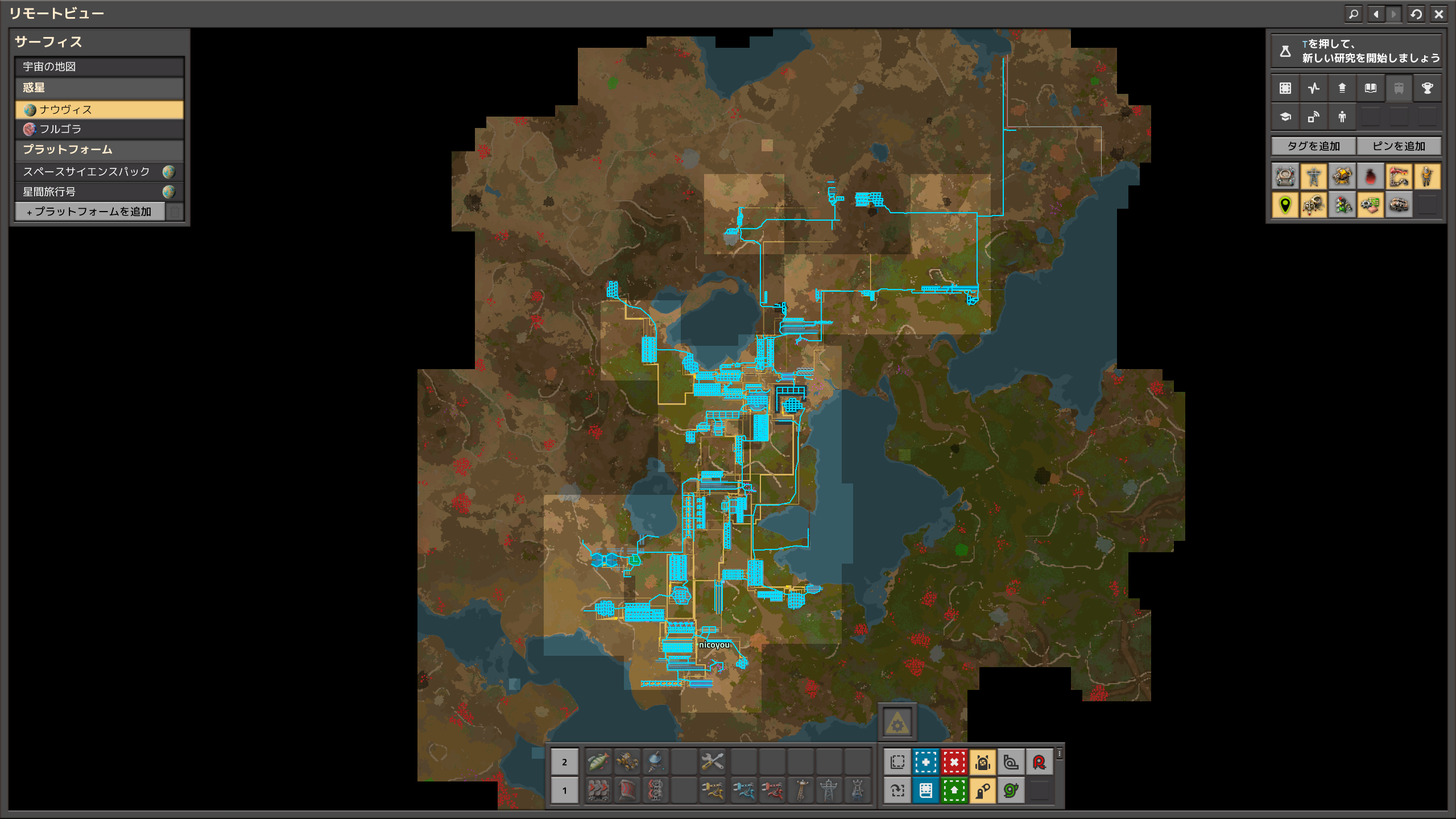
Building the Ultimate Factorio Factory Step-by-Step in Space Age
Strategies and blueprints for completing all research on Nauvis before Space Age
nicoyou.jpBackup and Emergency Power
Even nuclear-primary bases should keep a small, independent solar + accumulator circuit. Role: restart vector. When reactors black out, the backup trickle powers pumps, fuel transport, key roboports—just enough to restart the main reactor chain without hand-crafting. By sun-up, accumulators charge and full power restores.
Scope is tiny: defend only the essentials for reactor restart. Pole off the secondary power grid to critical equipment. Most of the base stays dark during recovery; that's fine. You're not saving the whole thing, just enabling automated restart.
Backup is powerful because it decouples failure recovery from manual intervention. Power dies; solar trickle charges accumulators; accumulators pulse pumps awake; reactors restart themselves. No panic, no micromanagement.
💡 Tip
Backup power isn't about saving the factory—it's about enabling self-restart. Keep it small, separate, and focused on the reactor block.
Common Pitfalls and Fixes
Accumulator Shortage
Most common solar mistake: add panels, forget batteries. Solar looks fine mid-day, then crashes at dusk. Night never comes; daylight always exists in your mind until it doesn't.
The fix is mechanical: 20 accumulators per MW, no exceptions. Stop eyeballing; use the ratio. When I stopped estimating "that looks like enough" and locked in 1 MW = 24 panels + 20 accumulators, night failures vanished.
Nuclear's parallel mistake: water starvation. You've placed tons of heat exchangers, but water can't reach them all. Bottleneck: single water line shared across multiple branches, pressure drops at the far end. Result: distant exchangers make no steam, turbines starve, power falls mysteriously.
Remedy: split water into dedicated lines per reactor group, shorten pipes, run ample pumps. Pressure loss is real; you need local capacity to overcome it.
Worst: heat pipes run too long or branch excessively. Temperatures at the far end drop below 500°C, and exchangers make warm water instead of steam. Turbines refuse to run; output crashes mysteriously.
Quick diagnostic: if your reactor outputs aren't rising as expected, check end-of-line heat temperatures first. If distant exchangers are cool, your heat path is starved. Remedy: shorten paths, reduce branches, split systems. Place exchangers next to reactors, not meters away. Heat is precious; don't waste it on plumbing.
Another trap: over-counting reactor fuel consumption and panicking. Fuel rods burn on a 200-second clock, not on demand. Over-generous uranium feeding runs rods dry faster than you think. The mental fix: assume full burn, plan Kovarex early, buffer via steam tanks and accumulators. Don't expect dynamic throttling; design for steady, generous operation.
💡 Tip
Reactor not outputting full power? Water, heat path, temperature—diagnose in that order. Fueling is rarely the culprit.
Kovarex Startup Confusion
Many players place a centrifuge and expect U-235 to multiply... and wait forever. Kovarex needs 40 U-235 to bootstrap. Until then, conventional uranium processing slowly accumulates it. Skip this and you'll consume your stash hand-feeding reactors.
Tactic: isolate the 40-unit Kovarex stash in a separate locked container. Never let fuel rods pull from it. Once Kovarex runs, U-235 production becomes exponential and self-feeding.
Circuit logic in 2.0 makes this dead simple: lock enrichment input until stock hits 40, then permit enriched output to fuel reactors. Two separate stockpiles: one for bootstrap (guarded), one for circulation (free).
→ Reference
Mechanics: https://wiki.factorio.com/Kovarex_enrichment_process|Kovarex enrichment process - Factorio Wiki. Startup condition is exactly 40 U-235—no shortcuts. Plan the logistics before you're stuck.
Advanced: Space Age and Megabases
Space Age shifts the calculus. Solar effectiveness varies radically by planet. Nauvis remains the reference standard (42 kW average per panel), but Vulcanus and Gleba see reduced daylight. Ratios shift accordingly, and community discussions often quote Nauvis 0.84672 vs. Vulcanus 0.72576. Use these as trend guides, not absolutes, unless you've verified them in-game.
Nuclear, by contrast, remains solid regardless of planet. Output is output. The real late-game scaling trade is UPS cost vs. expansion ease. Megabases (3k+ SPM, billion-unit scales) start hitting compute limits. Fluid and heat updates, especially via nuclear, weigh on frame rates. Extreme bases often shift toward solar grids that run on simpler logic.
That said, don't panic: nuclear at mid-scale (1k–2k SPM) runs fine. The memo "solar is better for mega" is not "nuclear is bad for mega"—it's "once you're pushing compute limits, pick the lighter math."
Tactically, I've found megabase scaling most pleasant when I stop thinking "make one gigantic power plant" and start thinking "mass-produce solar tile chunks via train". Build a rail network; spawn chunks of standardized solar at end-of-line and feed them to the grid. Expansion becomes logistics, not engineering. Reactors don't scale that way (you can't tile 4-reactor clusters easily), so the practical advantage swings to solar once the base is truly mega.
→ Reference
https://forums.factorio.com/viewtopic.php?t=118649|Factorio Forums: Power discussion covers multi-planet balance. https://steamcommunity.com/app/427520/discussions/0/4634862385195159813/|Steam: Solar ratios by planet gathers community calculations—treat them as starting points, not gospel, until you run the numbers yourself.
→ Lived experience
By 3,000+ hours and mega-base terrain, I'd switched to mass-producing solar blocks via train rather than hand-scaling reactors. Once one clean tile is designed, stamping 100 copies is pure logistics—no re-thinking wiring, no double-checking heat paths. The effort-to-output curve flipped decisively toward solar at that scale.
💡 Tip
Megabase power tips: Build a solar tile. Via train logistic, place identical copies deep into your base perimeter. Feed them all to a central substation grid. Expansion becomes repetition—no re-engineering, no fluid re-balancing.
Next Steps
Start by reading your power screen. Note the current MW draw. Now you have a number. Multiply by 23.8 → solar panels. Multiply by 20 → accumulators. Round panels up, stake out a grid space, and build your test block. Run a day-night cycle. Accumulators full at noon? Night dip below zero? Adjust next block size accordingly.
For nuclear: don't place one reactor alone. Plan for 2 or 4, and leave space to connect them. Plop water side-on; stage heat exchangers close; sketch steam/turbine beyond. Water and heat first, fuel rods second. Once those work, rods are the easy part.
Blackout safety: if accumulators are draining every cycle, you're underpowered. If they're climbing all day and never discharge at night, night demand is vanishing (check for idling smelters or disabled production). Watch the shape of the charge curve—it tells you if you're out of balance.
For backup: spare a corner of your map for tiny solar + batteries. Feed it via separate wire to key roboports and pumps. Forget about it until a biter raid cuts main power, then watch auto-restart kick in at dawn. One less thing to panic about.
💡 Tip
Design discipline: lock in your MW, calculate your tile, scale by copying tiles. Stop guessing. Repeatability beats precision every time.
Once ratios are muscle memory, power design becomes exchanging megawatt counts for required placements. Redo nothing each scale-up. The real mental shift is treating power as a solved ratio problem—calculate once, tile infinitely, monitor via the power graph. You're no longer intuiting; you're executing a formula. That's when factory growth stops stalling on power and starts racing.
Dive deeper on Kovarex timing and the full reactor fuel cycle once you hit uranium—read https://wiki.factorio.com/Nuclear_reactor|Nuclear reactor - Factorio Wiki and cross-check with community execution guides. Seeing both the schematics and real-world examples closes the gap between "I know the numbers" and "I can run it reliably."
Summary
Power design is about choosing a scale, sticking to the ratio, and building margin. Nauvis solar defaults to 25:21; nuclear clusters in evens. Neither is absolute—trade space for simplicity (solar) or simplicity for density (nuclear). Confused? Hybrid divorces the load so each source plays to its strength. I spent thousands of hours locking Nauvis baselines, then adapting to megabase and multi-planet games. Start simple, expand with confidence in the math, and the rest follows.
Takuma
Over 3,000 hours in Factorio. A production line design specialist who has achieved 1k SPM megabases in multiple configurations, applying his professional plant engineering expertise to factory optimization.
Related Articles
Factorio Beginner's Guide | Your First 60 Minutes of Automation
Factorio Beginner's Guide | Your First 60 Minutes of Automation
【Factorio】Vulcanus Strategy Guide | Rapid Setup with Lava Resources and Power Generation
【Factorio】Vulcanus Strategy Guide | Rapid Setup with Lava Resources and Power Generation
[Factorio] Space Platform Design & Operation: 3 Practical Patterns
[Factorio] Space Platform Design & Operation: 3 Practical Patterns
Factorio Space Age Complete Planet Strategy and Progression Order